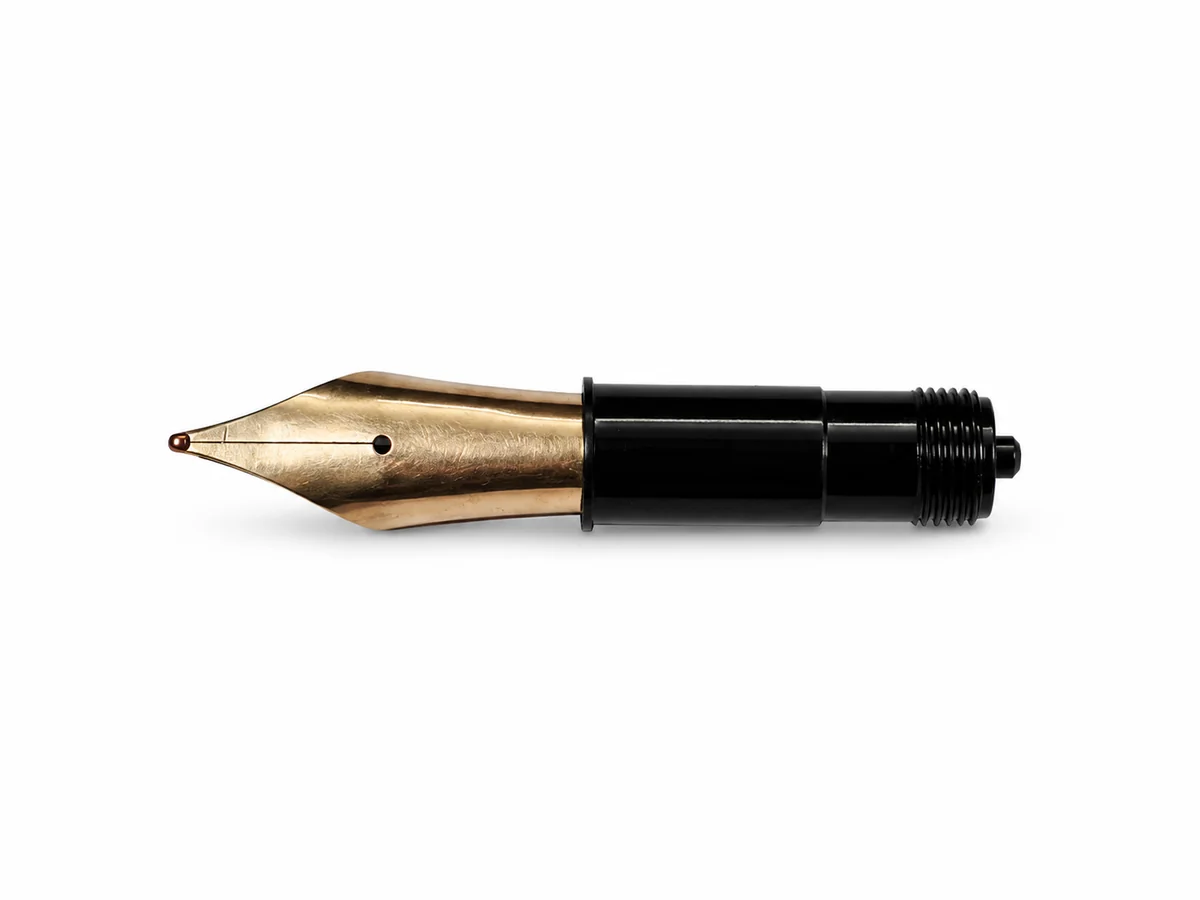
Understanding Fountain Pen Nib Sizes
Fountain pen nib sizes — EEF, EF, F, M, B, and BB — describe the width of the ink line produced on paper. Unlike ball pens which have consistent line widths, fountain pen nibs are influenced by writing pressure, paper texture, ink viscosity, and hand speed. Choosing the right nib size is one of the most personal decisions in pen selection.
The Six Standard German Nib Widths
EEF — Extra Extra Fine (~0.3mm)
EEF nibs produce hair-thin lines and are the closest fountain pen equivalent to a 0.3mm mechanical pencil. They are popular among writers who work in small notebooks (A6, pocket), writers of East Asian scripts (Kanji, Devanagari) where character density matters, and anyone who needs extreme precision.
Best ink: Low-viscosity, well-behaved inks. Avoid sheen and shimmer inks at EEF — the channel is too narrow for glitter particles.
EF — Extra Fine (~0.4mm)
EF nibs are the finest practical choice for everyday writing. They produce a noticeably fine line without the occasional scratchiness of EEF. Popular in professional contexts — legal documents, small handwriting, technical note-taking.
F — Fine (~0.5mm)
The most versatile nib width globally. Fine nibs produce a clean, legible line that works on most papers, with most inks, at most writing speeds. If you are buying your first fountain pen nib, Fine is the safest choice.
M — Medium (~0.6mm)
Medium nibs offer a satisfying balance between expressiveness and control. They show ink shading and sheen more noticeably than Fine nibs, making them the preferred choice for ink enthusiasts who want to see their ink's full character on the page.
B — Broad (~0.8mm)
Broad nibs write with a noticeably wet, expressive line. They are excellent for journaling, signature pens, and anyone with large handwriting. Shimmer and glitter inks perform beautifully through broad nibs because the wide channel accommodates particles without clogging.
BB — Double Broad (~1.1mm)
Double Broad is the most expressive fountain pen nib, approaching the territory of calligraphy. BB nibs are primarily purchased for signatures, decorative writing, and enthusiasts who simply enjoy a very wet, bold writing experience. They are not suited to small handwriting or cramped notebooks.
Factors That Influence Your Choice
- Handwriting size: Small handwriting → Fine or EF. Large handwriting → Medium or Broad.
- Paper quality: Low-quality or absorbent paper (newsprint, cheap notebooks) feathers with broader nibs. Stick to Fine or EF on poor paper. Tomoe River, Rhodia, and Clairefontaine papers handle any nib size.
- Ink preferences: If you love sheen, shimmer, and shading — go Broad or Medium. If you use workhorse inks for utility — Fine or EF.
- Climate: In humid climates (as in most of India during monsoon), ink dries slower, making broader nibs prone to smearing on smooth paper. Fine nibs are safer during humid months.
German vs Japanese Nib Width Standards
Note that RS Writing Instruments nibs follow German nib width standards (Bock and Jowo). Japanese nib standards run approximately one size finer — a Japanese Medium is roughly equivalent to a German Fine. If you are comparing our nibs with Japanese pen brands, account for this difference.