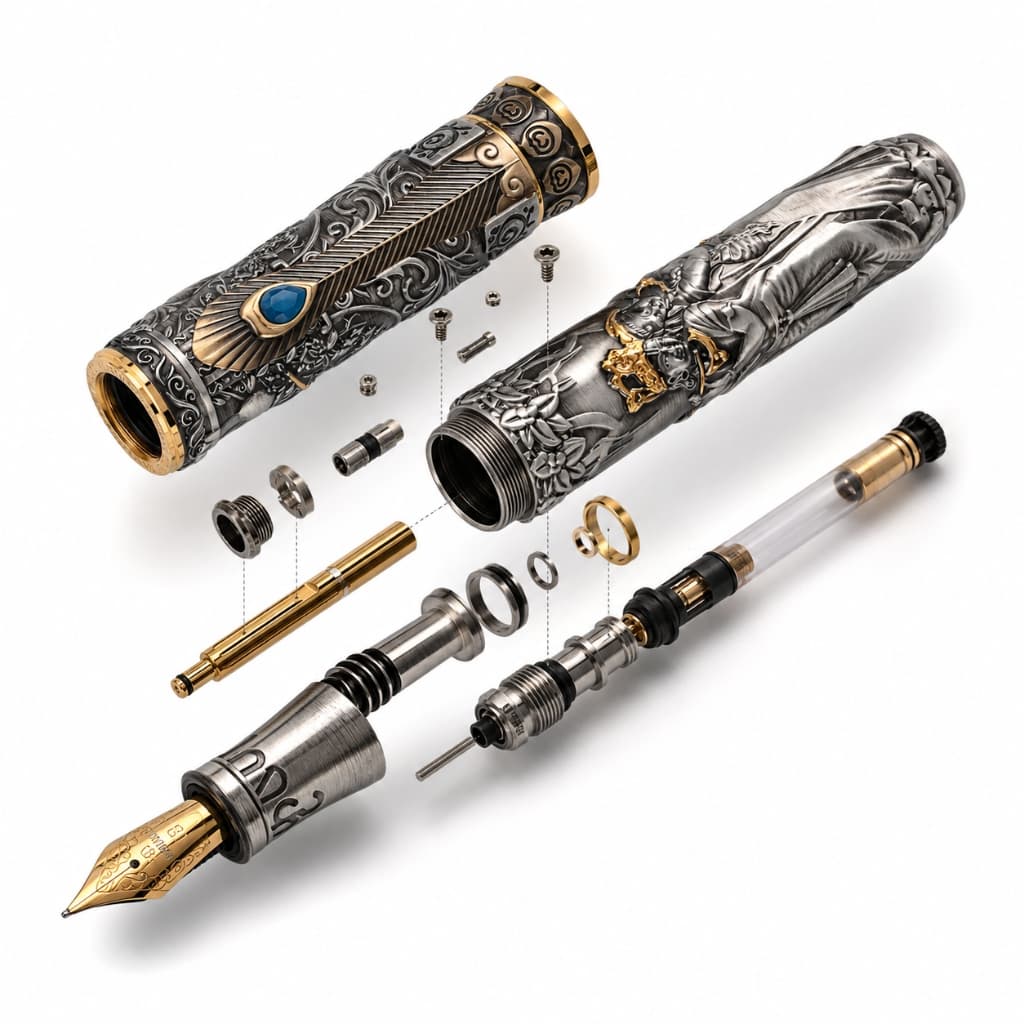
What Is an Ebonite Feed?
An ebonite feed is the ink-delivery component of a fountain pen, machined from vulcanised natural hard rubber (also called ebonite or hard rubber). It sits beneath the nib, channelling ink from the reservoir to the writing tip through a precisely engineered network of capillary grooves and fin channels.
At RS Writing Instruments, master nibsmith Sanjay Singh has been hand-cutting ebonite feeds on a precision lathe since 2011. In over 50,000 feeds produced, the core principle has never changed: the capillary groove geometry determines everything about how a pen writes.
How Does a Fountain Pen Feed Work?
A fountain pen feed exploits two physical phenomena simultaneously: capillary action and air-ink exchange. The thin grooves cut into the feed body draw ink from the reservoir via capillary tension. As ink flows towards the nib, an equal volume of air must flow back into the reservoir — otherwise a vacuum forms and the pen starves.
The fins (horizontal ridges on the underside of the feed) serve as an ink buffer — a small reserve that prevents hard starts after the pen is picked up after sitting idle. The deeper and more precisely cut these fins are, the better the pen recovers from rest.
Why Is Ebonite Used for Feeds?
Ebonite's superiority as a feed material comes from three properties that synthetic plastics cannot match:
- Natural wettability: Hard rubber is naturally hydrophilic. Ink wets the capillary walls immediately, producing instant flow without requiring pen shaking or priming.
- Dimensional stability: Ebonite does not swell or shrink with temperature changes the way ABS plastic does. A feed machined to 0.3mm groove width retains that precision for decades.
- Machinability: Hard rubber can be cut to tolerances of ±0.05mm on a manual lathe, allowing channels to be individually tuned for different nib widths and ink viscosities.
Single, Double, and Triple Channel Feeds
The number of ink channels in a feed directly controls flow volume. RS Writing Instruments offers three configurations:
- Single channel: Dry, controlled flow. Ideal for fine nibs, EEF, and EF points where precision matters more than wet writing.
- Double channel: Balanced flow. The most popular configuration for Medium to Broad nibs, providing consistent writing without blobbing.
- Triple channel: Wet, expressive flow. Suited for Double Broad nibs, stub grinds, and calligraphy work where generous ink saturation is desirable.
Parker 51 and Sheaffer Feed Geometries
Not all feeds are interchangeable. Vintage-geometry feeds — designed for Parker 51 and Sheaffer pens — have specific shank profiles, section diameters, and collector fin spacings that differ from modern #6 feeds. RS Writing Instruments produces feeds in both Parker 51 profile and Sheaffer profile geometries, making them one of the very few Indian suppliers of vintage-format hard rubber feeds.
How to Heat-Set an Ebonite Feed
Heat-setting is the process of thermally adjusting an ebonite feed to achieve a perfect seal with the nib. Using a heat gun set to 80–90°C (never open flame), the feed is briefly warmed and the nib pressed firmly into position. The ebonite softens slightly, flows around the nib's tail curvature, and cools to form an airtight, leak-proof bond.
This is a process that requires practice. Over-heating causes feed deformation; under-heating leaves micro-gaps. At the RS atelier, each feed-nib assembly is tested for ink draw before dispatch.
Frequently Asked Questions About Ebonite Feeds
How long does an ebonite feed last?
Properly maintained ebonite feeds outlast the pens they are fitted to. Vintage Parker 51 feeds from the 1950s are still in active use today. Ebonite does not degrade with regular ink contact — it actually improves with use as the capillary surfaces become conditioned.
Can ebonite feeds be used with all inks?
Ebonite is chemically resistant to most fountain pen inks, including iron gall, pigment-based, and shimmer inks. However, bleach-based ink flush solutions should be avoided as they can oxidise the rubber surface over extended contact. Flush with clean water and neutral pen flush solution only.
What is the price of ebonite feeds in India?
RS Writing Instruments ebonite feeds start at ₹75 for standard single-channel configurations and go up to ₹450 for specialty triple-channel or custom-profile feeds. Wholesale pricing is available for orders above 250 pieces.